
I have not been in touch with my research participants for some time due to my attentions being focussed upon the TMA 1402 Creative Innovation module from January to April. Following a tutorial with Charlie in which we discussed the realities of producing a 6 piece collection of outfits (one outfit in response to each research participants contributions) in the allotted time frame, I have decided to focus upon two of my research participants and therefore creating two outfits. I have ambitions to develop new, innovative methods of pattern cutting when developing solutions of garments that ‘fit well for a lifetime’. This in-depth exploration takes time and I am hopeful that by focussing upon producing just two outfits, I can fully realise solutions in my output of a high standard.
Selecting two research participants from the 6 takes critical reflection as I revisit the photography and commentary gathered in earlier research activity. I reference the book ‘Oral History Theory’ by Lynn Abrams when making the selection;
“A ’successful’ interview – one that perhaps produces a nice coherent and fluent narrative containing a balance between information and reflection – is likely to be the product of shared values between the parties, a good rapport and the willingness of the interviewer to permit the respondent to shape the narrative, avoiding unnecessary interjections“ (Abrams, 2010).
I consider the rapport I had with participants in those earlier meetings as well as pondering over the polaroid photographs documenting the shapes of their bodies. I wish to select body shapes that most reflect the ‘typical signs of ageing’ (Lennon et al. 2017) I had discovered in earlier reading and therefore I decide to select research participant 1 and 5.
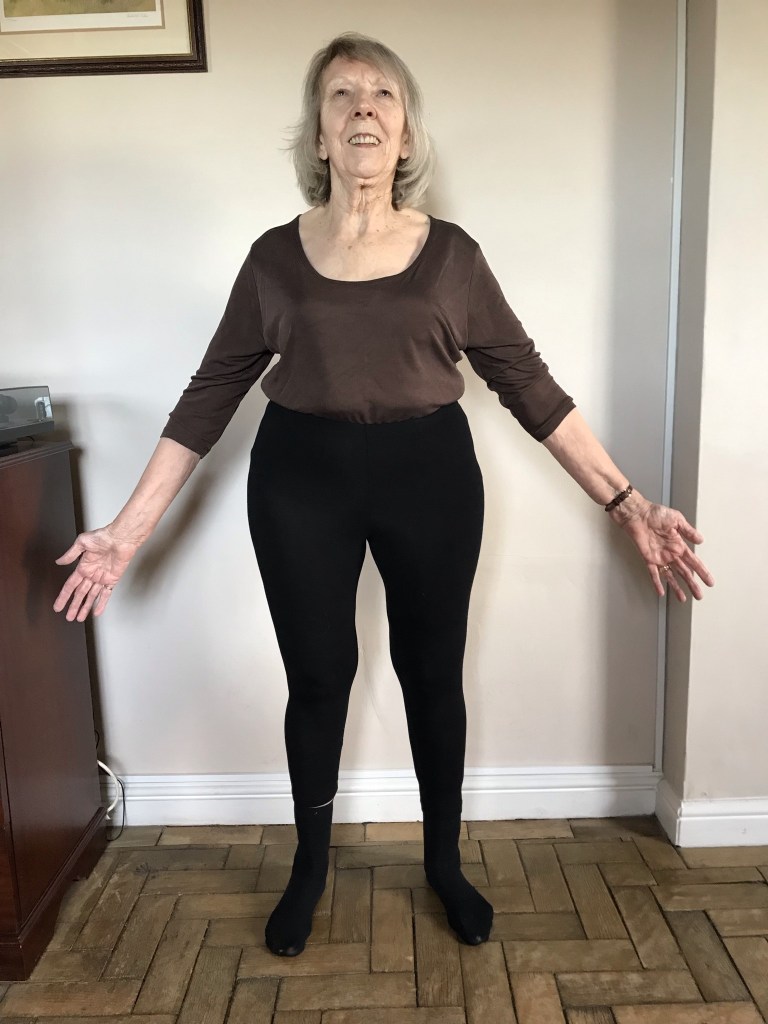
Figure 1 Participant 1 O’Leary (2022) [photograph]
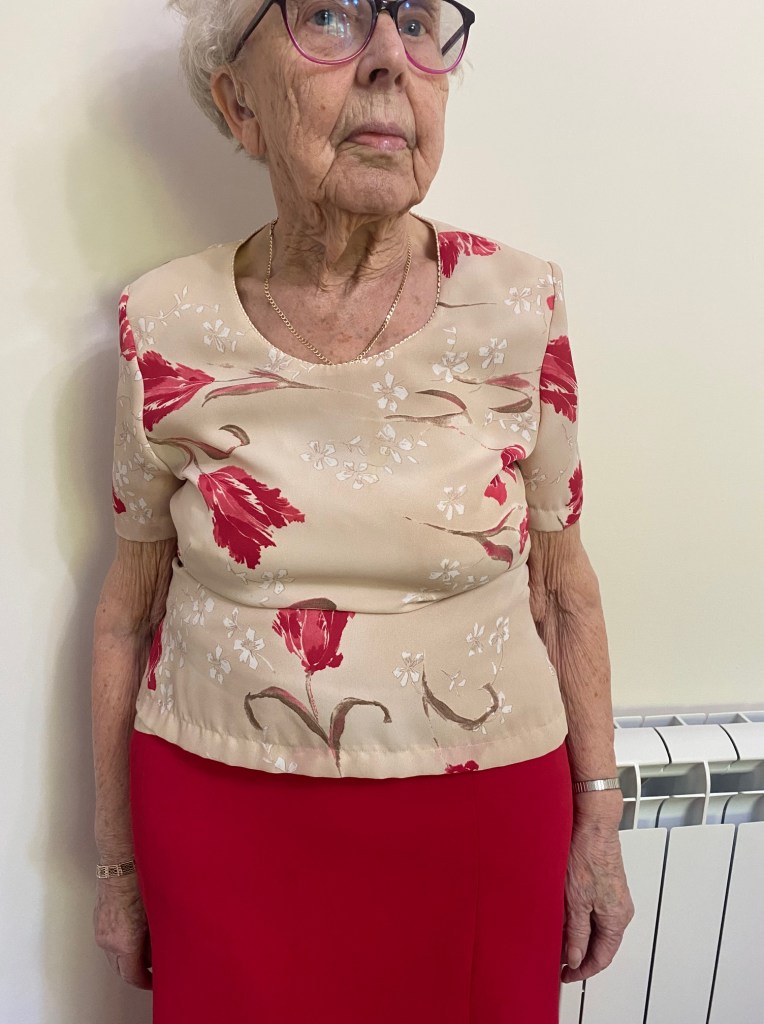
Figure 2 Research Participant 5. O’Leary (2023) [photograph]
I acquired ethical clearance to work with these participants in the earlier module, TMA 1434, and upon checking with the module leader, this ethical clearance stands for the duration of the project. Work that I intend to undertake for this coming module does not waiver much from the original research proposal, however, I feel it important to produce revised ‘Participant information Sheets’ and ‘Consent Forms’ to ensure that I am entirely transparent with my expectations from the participants in this next phase of the project. This revised documentation (seen in appendix one and two) reflect my ambitions to;
- Interview the participants on a one to one basis
- Waiver their anonymity (to refer to them with their Christian names)
- Analyse an outfit from their wardrobe that they retain for sentimental reasons
- Re-measure their bodies (to ensure body data is accurate)
- Meet them on a regular basis to check for fit
- Photograph them with/wearing the completed garments
Interviews;
I conducted the interviews in the comfort of the participants homes. Conducting interviews within the home environments in which Barbara and Margaret felt secure, I hoped that they would talk more freely about the emotions they associated with their ‘sentimental’ garments. I had printed off two copies of the consent sheet and participant information sheet so that both Barbara and Margaret could read the information as I read aloud. I wanted to be sure that they understood fully my expectations of their involvement in the project before signing the consent sheet. I recorded the interviews on my phone to transcribe at a later date and refer to through the garment analysis I had planned in the following weeks. However, in hindsight I wish that I had recorded from the moment I arrived at their homes as the conversation that proceeded the ‘formal interview’ had in fact held some qualitative data in the shape of memories stirred when they presented the outfits to me for the first time.
Margarets interview was conducted on 21st May. Present was myself, Margaret and her two granddaughters. Margaret selected a red ‘Jacques Vert’ viscose 3 piece outfit comprising of a skirt, top and jacket that she had worn to her grandsons wedding in 2005;
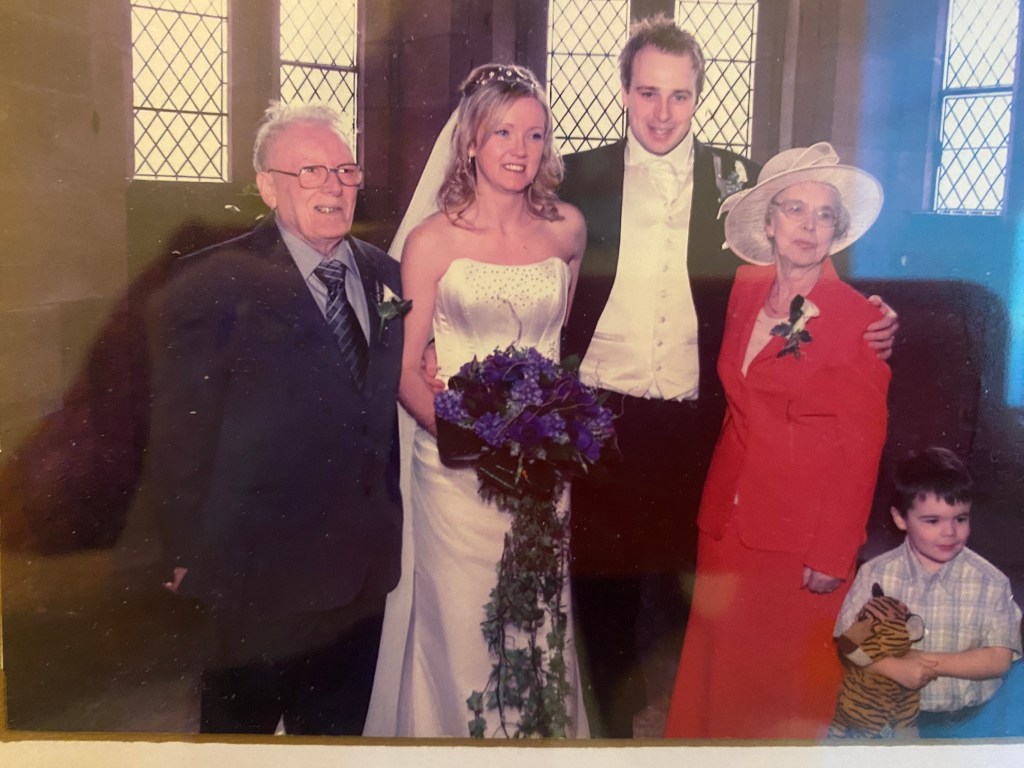
In hindsight, having two additional people in the room brought positive and negative outcomes. Positive being that her grandchildren were at the event at which Margaret had worn the red outfit. On the odd occasion that Margaret required confirmation of details such as the year and exact location the wedding had taken place, her granddaughters were able to clarify. They were able to reflect together upon the shared memories of the event which in turn encouraged and expanded the dialogue around the outfit, leading to a more rich and detailed recollection for me to record and understand better the significance of the outfit to Margret.
However, I left the interview considering if Margret may have held back a little, especially when discussing her late husbands attendance at the event. I had an instinct that Margaret might have been more open about this if her granddaughters hadn’t been there. By expressing limited feelings around the fact that this had been the final family occasion he had been able to attend before a Dementia diagnosis prevented his attendance at consequent family gatherings, I felt that perhaps, through holding back, she had been protecting her grand children from the sadness associated with this memory.
Barbara’s interview was conducted on Wednesday 24th May at her home. Present were interviewee, interviewer and my mother (a friend of Barbara’s).
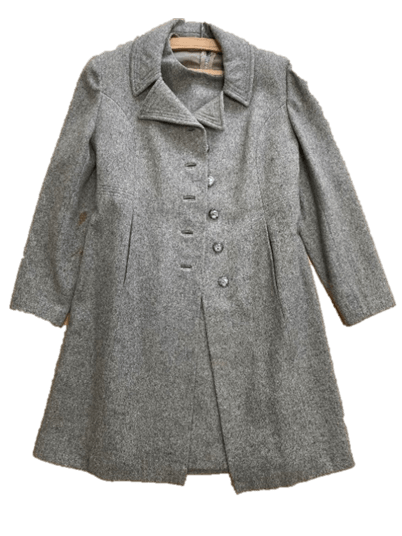
Barbara had carefully selected a range of outfits for me to view, all of which held sentimental value to her and were from the 60’s and 70’s. She explained that she kept them in a trunk in the loft and spent some time talking through the occasions upon which she had worn the different items. It was decided that we would select just one outfit for the sake of this research project and agreed that the grey wool dress with overcoat would be the most appropriate for me to work from considering my desire to develop adjustable tailored pieces.

Elements from the full transcription of the recording can be found in appendix 3 and 4 and I have carefully selected the most inspiring, emotive aspects of each interview and peppered the text throughout my sketchbook. I have attempted to capture the uniqueness of each interviewees individual voice, including pronunciation, hesitations and pauses, however I believe that the transcription fails to truly capture the moment. It is my view that the laughing, back ground noise and hesitations are what makes the interviews so impactful and I make a note to explore using sound in the final curation of the output within the exhibition.
These interviews allowed me to deepen my understanding of the sentimental value of these items. Through hearing the stories of when Barbara and Margaret had worn each outfit, I saw the items in a different light, an artefact of memory that spoke of their past and identity. The burden of responsibility weighs heavy as I contemplate an output that honours these cherished items and the stories of Barbara and Margaret, whilst addressing the bigger cultural issue of gendered ageism.
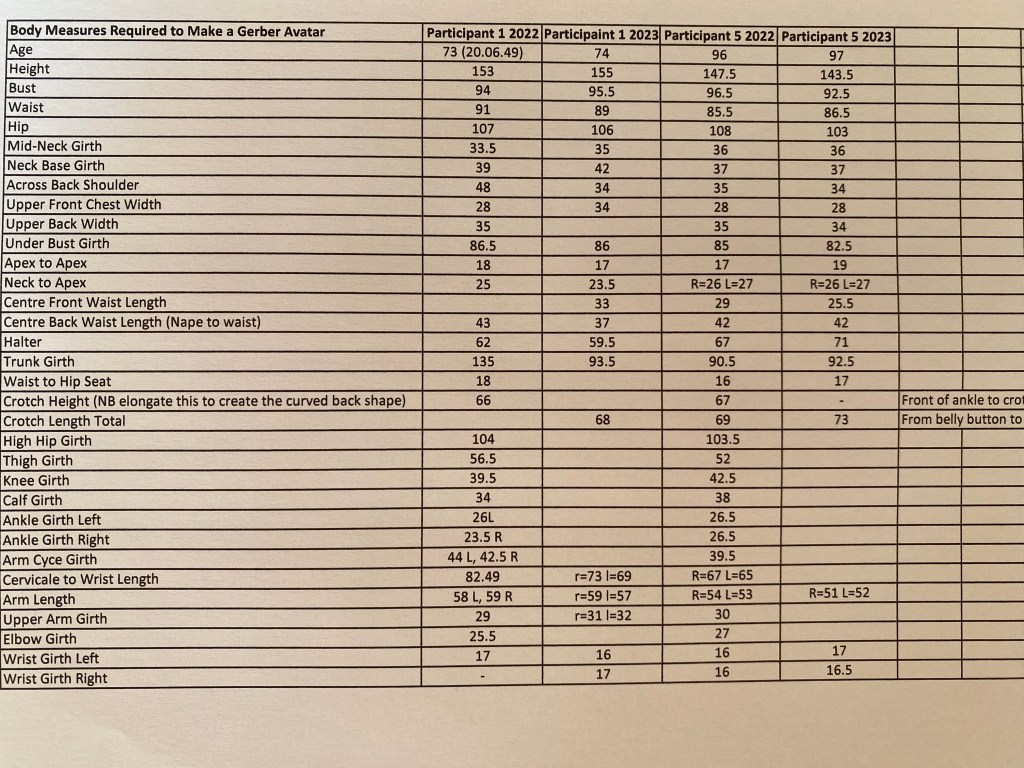
The final phase of the interviews includes re-visiting the body measurements of both participants. I had collected this data in earlier research, however this was over a year ago and I had to be sure that I was working towards the correct size (see appendix 5).
Next steps;
Pricking a pattern off the garments to recreate exact replicas
Analysing loaned garments in sketchbook pages.
Sourcing fabrics to replicate original/adapt from
Building 2 x mannequins to reflect body shapes.
Explore possibility of including audio in final curation.
References;
Abrams, L. (2010). Oral history theory. Routledge. https://doi.org/10.4324/9781315640761
Lennon, S., Johnson, K., Rudd, N. (2017). Social Psychology of Dress. Bloomsbury
Appendix One; Participant Information Sheet
Participant Information Sheet
I am a student on the MA in Creative Pattern Cutting at The University of Huddersfield. My research interests lay in the field of female ageing and the role that clothing plays in the cultural ideal that women age successfully by remaining youthful.
The aim of this next phase of the project is to source garments that my research participants have retained in their possession for sentimental reasons. They may no longer fit, but participants keep them for emotive reasons.
My overall ambition is to recreate said garments using adaptive methods of pattern cutting and garment construction, enabling garments to evolve over time as the owner’s body ages.
The research design is as follows;
Part One – One to one discussion with participant (1 hour);
Participants will be requested to share a garment from their wardrobe that they have retained for sentimental reasons.
As we explore the garment together, the researcher will steer discussion to include themes around;
- Sentimental fashion – what garments (if any) have you kept for sentimental reasons? For example, wedding gown, going away outfit, outfits worn to children’s wedding.
- Sharing memories of the time/s it was worn.
- What emotions do you experience when looking at this outfit now?
Location; At a location most desirable to the participant (their home, researchers home or a public place such as a café)
In attendance; Researcher, Participant (chaperone if requested)
Method of data capture; Audio recording on researchers mobile phone. Note making.
Part 2 – Body measurements (20 mins);
Body measurements will be taken of the participant followed by body photography. This photography will be approached as a fact-finding activity to capture the physical attributes of the participant to support later pattern cutting/garment making activity. Participant to remain fully clothed, however closer fitting garments are helpful here to enable silhouette and shape to be identified in photographs.
Location; At a location most desirable to the participant (their home, researchers home or a public place such as a café)
In attendance; Researcher, Participant (chaperone if requested)
Method of data capture; Note making on spreadsheets.
Part 3 – Garment analysis;
Participants can choose to;
A; Loan garments to researcher to use in pattern cutting activity for the duration of the project (until 25th August 2023). The garment will remain intact and undamaged whilst in the researcher’s possession. It will be stored either within the researchers home or in a locked cupboard in the researcher’s design studio. Should garments be transported (to University for example) it/they will be carried carefully in a locked suitcase and not left unattended.
B; Retain the garments within the participants possession and allow researcher to take photographs of the garments. Including close up photographs of details and method of construction.
Location; At a location most desirable to the participant (their home, researchers home or a public place such as a café)
In attendance; Researcher, Participant (chaperone if requested)
Method of data capture; Photography
Part 4 – 3 x Fit sessions (1 hour each);
Conducting ‘fit’ sessions with the participants, trying on garments that have been made to fit them based upon the information gathered in research activity step 1 – 3 outlined above. This event will include photography, note making and video capture. Approximate dates;
W/C 3rd July 2023 (mock-up/toile)
W/C 17th July 2023 (first fit in final fabrics)
W/C 7th Aug 2023 (final fit)
Location; At a location most desirable to the participant (their home, researchers home or a public place such as a library for example)
In attendance; Researcher, participant (chaperone if requested)
Method of data capture; Photography, note making, videography
Part 5 – Final outcome photography;
Final photoshoot of participant in completed outfit. To be conducted at a photography studio (location TBC). Approximate date W/C 14th August 2023. Outcomes from this photo shoot will require approval from the participant before being used in the following ways;
- To support the researchers final portfolio submission for the module TMA1449
- In promotional materials to advertise researchers final exhibition (such as social media promotion, flyers, posters)
- Final MA exhibition (date pprox.. October 2023)
Location; Photography studio (location TBC)
In attendance; Researcher, participant (chaperone if requested)
Method of data capture; Photography, videography
I will ensure that this research adheres to the DATA Protection Act (2018), keeping DATA confidential by replacing named participants with fictitious names to protect their identity. All DATA will be stored on a password protected storage device and not used for any purpose other than that of the research before being destroyed upon completion.
You have the right to withdraw at any time and should you have any queries or complaints please contact the researcher in the first instance; U2183040@unimail.hud.ac.uk.
Appendix Two; Consent Form
Consent Form
I agree to the use of my data in the research and understand that the data will be kept securely and safe on a password protected storage device and the university K-Drive and used only for the purposes of the research before being destroyed. I have the capacity to make my own decisions and I understand that I have the right to withdraw at any time:
Name: ………………………………………….. Signature: ………………………………………………
Date: …………………………………………… Researcher Signature: …………………………………
Please indicate if a chaperone is required when meetings occur between researcher and participant (as outlined within the ‘Participant Information Sheet’);
Yes, chaperone required;
No, chaperone not required;
If yes, please indicate if you would like to arrange your own chaperone or if you would like the researcher to arrange one;
I will arrange for my own chaperone;
I am happy for the researcher to arrange a chaperone;
Appendix Three; Transcript of Interview with Barbara
Interviewer; OK, so Barbara, the garments that you have leant me is a beautiful wool grey shift dress with coordinating overcoat. Can you tell me a little bit about this outfit? What year did you wear this?
Barbara; I think I would have got that when my mother bought it for me to go to a wedding. And I think I must have been about 16, I was still at home. I hadn’t left to go nursing and I think it was somewhere around 13 or 15 Guineas. It was quite a lot of money in those days, I think it was probably 12 or 13 Guineas, something like that. It was all Guineas then. I wore it, you know, to church as well with a straw boater hat and I wore it quite a lot. And then I think the last time I really remember wearing it (because I’d have perhaps grown out of it a little bit!) would be in ‘73 possibly when I was a godmother someone. And so it was church again. So I think that’s probably the last time I might have worn it.
Interviewer; So what year was it? When you were 16, Babs, what year was that?
Barbara; 1965
Interviewer; So you got your wear out of it by the sounds of it if you wore it from ‘65 to ’73?
Yes, yes, very quite a lot. Yeah. But I don’t think it’s ever. Been cleaned, it might have been but.
Interviewer; You said it was about 13 Guineas. Do you remember going to buy it?
I do remember where. We bought it, we bought it in a dress shop called Charles’s in Darlington. On the High Road. Yeah, quite it was. It was a dress shop. It’s not there anymore, obviously. But it was, you know, ladies, Outfitters.
Interviewer; And did you buy off the peg, Babs or did they fit it to you?
Yes, I know it’s just off the peg. I don’t know what size it is. It might be a 12 or a 10? It is small.
Interviewer; It looks small.
They didn’t have as much information on them in those days they haven’t even got labels about care or washing.
Interviewer; So you went with your mum, did she often buy you your clothes? I suppose at 16 your mum maybe would have still been buying them?
Yeah, well, I wasn’t eerrmmm, I had no money!
Interviewer; Yeah, yeah, of course, of course.
No. Yeah, so for anything special like that, she would. Yeah, if I needed a new coat for example.
Interviewer; It’s beautiful. Yeah, I can see the labels there. I’ll do a bit of research into that.
So it does evoke memories when you look at it then of things like the christening and……
Oh, yes. Yeah, yeah, yeah, yeah. Yeah. I mean, she’s in her 50s now, the baby whose christening it was!
Interviewer; And what was the wedding that it had been bought for originally, who was that?
I’m thinking yes. I think it was just a friend of the family. Yeah, I think it was. Well, we called her Aunty June but she wasn’t a real Aunty. Yeah. Friend of my mother’s. And it was her daughter, you know. So would you, I suppose a bit like now, you would have spent more on items that you would wear to church?
And it was still the era where you had your best clothes. You know very much we tend to wear the same clothes all the time now. You know, you had clothes for best then. If you got something for Christmas, like a jumper or something. Had to last that winter. You know, Mother often used to knit us a jumper every winter. And that was your best of clothes.
Interviewer; And so this was your like best?
Yes, the best outfit I suppose, yes.
Interviewer; And you wore it to church regularly, yeah? So you would literally put your Sunday best? So it wasn’t just for occasional or a one off use like a wedding?
No, no, no.
Interviewer; Does it make you feel nostalgic because we’ve got. Hanging up on the back of the door there. We’ve got the little spotty shift dress as well, and the shirt dress. Why have you kept these garments Babs?
I don’t know. I mean that shirt I did wear until I had the children, probably you know, for the first few years of being married, I left it down and I, I used to wear the dress an awful lot. I got that in, as I say, a little boutique. It could have been in Darlington as well. But it was just a summer dress. But I remember having that when I was nursing, so when I bought it, it must have been, I don’t know, ‘67/’68?
Interviewer; This spotty one? So when you said you bought that when you were nursing, does that evoke quite happy memories?
Yeah. Yeah. I remember you know, just wearing it when in the summer. I used to wear it to travel home in if it was really hot.
Interviewer; You speak of your nurse training with great fondness don’t you Mum (interviewers Mother in room also).
Yeah, yeah, yeah but I haven’t kept any clothes though.
Well, I suppose it just got put in the trunk in the loft and just stayed there, along with bridesmaids dresses. I’ve got bridesmaids dresses that Rachel wore.
Interviewer; So do you hold garments as memories? For example I do that, I suppose. Like there’s some stuff I can’t fit in anymore, but I just can’t bare to throw it away. Is that the same for you because you said you’ve got a trunk in the loft full of old clothes?
Well, I have a chest in the loft but it isn’t full. No, these are probably all I have left. I have got rid of stuff, you know, over time.
This lot, but when I’ve done gone through it, I suppose these are things that just I thought, no, I’ll keep that locked.
Interviewer; Well, I for one, I’m very pleased that you did!
So when we spoke last time, as you mentioned about going down to London. Was it to Biba or………?
I can’t remember what shop it was. I think it might have been one of the big department stores like Selfridges. We went in 1966. I know it was definitely 19.
Interviewer; OK.
No, we went in 1966 and we went in 1967. We went two years running myself and my friend made this trip. She had an aunt and uncle that lived in London so we had their house. The fact was, that he was a bank manager. And they went to Scotland for three weeks every year. So for two years running we went to London – at that age! Getting on the train, everybody was going the World Cup! It was absolute bedlam! Sally said ‘I’ll get on and find the seats’ so Sally gets on and finds the seats. Mother said ‘I shall never forget this picture of Sally sailing down the corridor and you with two suitcases trying to follow her!’
I can’t remember exactly which year I bought it – if it was the first year or the second year to be honest, but it was the 66 or 67.
Interviewer; Oh how lovely – so those are really fond memories then.
Yes of course. The second year I definitely had it with me then because by then Sal had been in College in London for a year and she’d met this lad and he had a friend, of course! And so we were going to meet up with them for a day but she had tooth ache, a great big fat face she was in a real state! She said ‘I can’t go. I can’t go. I can’t go looking like this!’. I said ‘They’re come to some tube station. You’ll have to go!’ And so I went in that dress and I stood there like a lemon looking for these two boys that looked vaguely as she described them!
Interviewer; And did you see them!?
Oh yes they came to Romford for the day!
Interviewer; So did you go out with them by yourself?
Oh, no Sal came, I think we went for a ride to Epping Forest or somewhere, I don’t know, we didn’t do anything very exciting. I remember standing there! They did, they turned up, yes!
Interviewer; Does Jeff remember you in these? Some of these outfits, does he? Does he say ‘I remember you wearing that’?
No, he wouldn’t really know. Well I think I’d probably only wear that grey one for this christening, you know, of a friend from nursing. But no I don’t think he would remember that specifically. But he remembers that little green dress.
Interviewer; And that was the green dress that you wore the night that you met him met him?
Yeah. So where was that, Barbara?
It was at a farm called Batham, which is between Buckthorn and Kirby Under-dale. It is an estate. Well, my friend Christine she got married in the third year of our Nursing studies. She had to get married.
Interviewer; What? The matron? Ohh I see. So what happened when she moved out it?
Well, they said ‘I hope this isn’t going to affect your studies’?
Well, you could in your third year, you see, you could live in or out. I lived in a flat in the 3rd year but I think, yeah, I think you could in your second, but I didn’t go until 3rd. So she was with Mark and Mark’s parents had a farm and they’ve got the house on the estate and it [the party] was there. You can’t really see it from the road. It’s just off the road up the hill to Kirby. So when I had the weekends free, I’d go and stay with Chris, you know, rather than go all the way home.
Interviewer; Right.
Well, I say weekend, you know, it maybe your days off when you used to get 1/2 a day off and then a late start as we started at 1:00. So that was weekly. But well, they weren’t full days off really, cause you’d have a late start with eight hours. You work from one to late, so that’s pretty great and a half off.
Interviewer; Yeah, of course. So did Jeff [go to the party]?
We had this mutual friend.
He knew Mark and the farmers. Hence all the farmers dances and he’d go. He got to know them, the two brothers, and you know, like Chris, she was in the room next door to me.
Interviewer; Right, OK, OK. So you were wearing that dress. Was it a party then for you to be in a dress like that?
Ohh, it was Christmas. It was between Christmas and New Year.
Some of these farmers had like a wing built off over the kitchen and there were 2 bedrooms in there that never got used. And it hadn’t been used for some time I don’t think. And there was green light distemper on the wall. So Chris and I, we just, we got some more paint and we just painted Christmas trees and painted on the walls like Christmas decorations! We had music up there and you know there was dancing and like a buffet and people came, people who we are still friends with now!
Appendix Four; Transcript of Interview with Margaret
So I guess the jacket, when did you wear the jacket?
It was appropriate that you were in red.
And I suppose why? Why have you kept this one? Because obviously, you’ve been to other weddings.
But I’ve worn it quite a lot. After 2005. Well, worn it to church and things like that.
Exactly. Had to get my money’s worth.
How much was it? Can you remember? How much did you spend?
Oohh can you [granddaughter 1] remember? We you went with me.
So you thinking that the suit, the whole lot would have been……..More than that?
Yeah, I think you can name it.
I don’t think it would. We went to the outlet shop.
Grandma likes to spend big when she goes for outfit!
Which is quite a lot to spend. On an outfit.
Yeah, yeah. So I can understand why you wanted to get your moneys worth out of it then.
That didn’t include the hat. The hat, bag and the shoes!
I think I’ve still got it in the back.
It was one of the last events he was able to attend. One of the last family events, yeah.
So I guess it does hold some sentimentality perhaps in that sense?
You were in a castle, weren’t you?
A good guess. That’s exactly what I’ve written!
(Calls from the kitchen) Hot water!
Oh, yeah, yeah, everybody laughed. But Julia.
What else do you? Remember of that event, Margaret?
Ohh my gosh, did you hurt yourself?
Yes, she did, actually. Yeah, your hat, your hearing aid came out.
Yes I got a little hole in it.
Honestly, everything went flying.
Yes, it’s a family event, yes, yeah.
Not to worry, that’s OK is have you got the hat on in that?
Photograph in the Hall way? Yes please.
She has got the hat on in that picture.
Well, I haven’t looked at it for ages, so no, not really, no.
So how old were you when the wedding was then if it was 2005? Margaret? Did you say you’re 97?
In 2005, would that be 78? Yeah.
Appendix Five – Revised Body Measures

 Blog for Rebecca O'Leary (U2183040) MA in Creative Pattern Cutting