With mixed emotions the moment has arrived – we have been introduced to our Major Project module! Initially I approach the module with trepid anticipation, caused by an overwhelming sensation that I am unable to achieve outputs that are worthy of 60 credits of an MA in the timeframe allocated. We have a mere twelve weeks of delivered sessions followed by five weeks of self-directed study. Up until now, the part-time route that I have been following has required me to study one module at a time (as my full-time counter-parts study two modules at a time). However, this final module sees all part and full time students allocated the same timeframe. The familiar sensation of anxiety stirs in my stomach as I contemplate the logistics of juggling study, personal commitments and work and think “how am I going to do this”! But experience has proven that through being placed in uncomfortable situations such as these, comes great personal and professional growth, and I reframe the sensation to being one of excitement at the opportunities that lay before me.
The module that proceeded this, TMA1402 ‘Creative Innovation’, saw me abandon my research theme to pursue a multi-disciplinary collaborative project. I have missed the indulgence of developing my own work, without having to seek approval of others or manage the working relationships of being part of a team. To entirely focus upon developing a creative output that explores further my initial ideas and brings together the knowledge acquired over the past twenty months of study is exhilarating – this is the moment I have been waiting for!
Before writing the project brief and Gannt chart for this module, I re-read my Research Proposal and assessment feedback from December 2021. This proved to be an invaluable experience as I was reminded of my initial ambitions for the project and the context of the final output. The assessors commentary suggests that I address the way in which I curate the final outcome through practice, literature and conference opportunities to shift societies focus from the physical appearance of our elders to respect for lived experience. It also suggested that I look at cellular ageing, fabric ageing and rejuvenation processes as well as other forms of longevity in support of broader transdisciplinary contexts and approaches that might offer unexpected innovations. Both the presentation/curation of the output and exploration into fabric ageing/rejuvenation are areas that I have failed to explore and make a note to address this in my upcoming work.
In an attempt to systematically plan, organise and project manage my outcomes, I begin to write a project brief. I use the project brief for TMA1449 as a template to format my own content and this forces me to consider how outputs will meet the learning outcomes;
| ASSESSMENT BRIEF | ||||||
| Course Title | MA Fashion Creative Pattern Cutting | |||||
| Module Title | Vision and Realisation Major Project | Module Code | TMA1449 | |||
| Student Name/Number | Rebecca O’Leary (U2183040) | |||||
| Tutors | Claire Barber, Charlie Goldthorpe, Katrina Whitehead, Devabrata Paramanik | |||||
| Learning outcomes | ||||||
| Knowledge and understanding | Upon successful completion of the module you will be able to: A. Systematically appraise and demonstrate how creative pattern cutting for fashion has advanced through research development to produce original outcomes. B. Critically evaluate and apply relevant skills and techniques applicable to fashion design innovative pattern cutting. C. Assess the currency, relevance and suitability of your project (individual or group) within a defined context. | |||||
| Abilities | D. Conceptualise and initiate experimentation, expansion and progressive thinking of fashion design and cut and originality in the application of subject knowledge to produce comprehensive designs which satisfy the objectives of the brief in a highly resolved manner. E. Systematically plan, organise and project manage your outcomes, using appropriate formats. F. Evaluate and apply a comprehensive range of visual, oral and written media to test, analyse and critically appraise and explain design proposals and to communicate ideas and information in a sophisticated and appropriate professional manner. | |||||
| Submission Date | Friday 25th August 2023 11:59 | Submission location | Brightspace | |||
| Project Title | A Gray Area | |||||
| The Brief | ||||||
| INTRODUCTION Imagine a world in which age becomes culturally valuable. Where signs of ageing are in fact celebrated, worn as a badge of honour and a visible marker of wisdom and valuable experience. A global society within which our elders are cherished as a vessel of cultural heritage from whom we can learn. Fashion plays an integral role in re-conditioning the cultural ideal that women age successfully by remaining youthful. This collection will use the discipline of creative pattern cutting to develop garments that travel with the wearer through the decades of her life, adapting and changing as her body encounters the natural process of ageing. AIMS This project aims to intervene with the societal norm of gendered ageism and support a cultural shift in which clothing and female age become a valued cultural asset within a well-being economy. OBJECTIVES • Through dialogue with research participants I will explore the role that garments play in ones attitude to ageing. What do they wear now that makes them feel like their best selves? What garments have they retained in their wardrobes for sentimental reasons? What would they still wear now if they could? • To develop pattern cutting techniques that support design longevity. What processes transform garments into adjustable and adaptable outcomes whilst retaining the original aesthetic? • To source and experiment with appropriate materials (fabrics and all garment components) to realise ambitions within the timeframe. • To curate garments into a final presentation that will encourage dialogue and question social norms around gendered ageism. PROJECT DESIGN 1. Co-produce/Co-create. One to one meeting with research participants capturing stories. Qualitative data capture. Storytelling. Oral histories. Recording dialogue. Quantitative data capture – body measures. Favourite outfit – use to inform next steps 2. Discipline specific research . Analysis of research participants favourite outfit. Recreate in toile form. 3. Discipline specific practice. Produce mannequins adapted to represent research participants body measurements. 4. Discipline specific practice. Exploration into adaptive garments. Adjustable outcomes that fit the body through the ageing process. Re-create the research participants favorite garments to become adaptive. Modular/Moveable parts? Toile form 5. Discipline specific practice. Fabric and trim sourcing/sampling. Performance fabrics? Enhance wellbeing/comfort/longevity 6. Discipline specific practice. Producing final outcomes with regular fit sessions with participants 7. Discipline specific practice. Gerber 2D pattern cutting and 3D visualisation software 8. Curation of final presentation | ||||||
| Output | ||||||
| Digital portfolio documenting exploration as outlined above. To include analysis of the intended audience. Fully realised adaptive outfits. Critical Reflection (online blog) | ||||||
| Project Timings | ||||||
| (See Excel spread sheet attachment for further detail). | ||||||
| References to Explore | ||||||
| Abrams, L. (2010). Oral history theory. Routledge. https://doi.org/10.4324/9781315640761 Ana Hriscu. (2017). FASHION ETHICS: A PATH TOWARDS HUMAN PROGRESS AND WELLBEING. Agathos, 8(2), 155-160. Foster, L. (2001). In Praise of Older Women. Textile View, 56, 53-55 Moorhouse, D. (2017). Sustainable design: Circular economy in fashion and textiles. The Design Journal, 20(sup1), S1948-S1959. doi:10.1080/14606925.2017.1352713 The Future of Ageing 2022. [Artefacts Designed to Support Ageing] Exhibited at The Design Museum July 20 – Sept 25 2022. | ||||||
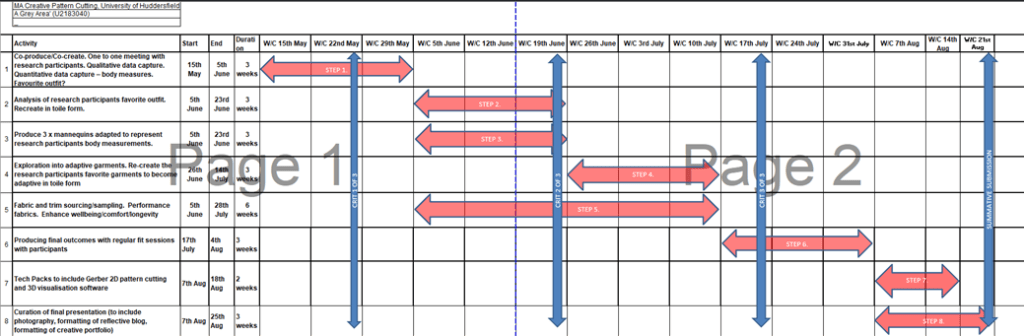
I can then use individual elements of the Project Design to formulate a Gannt Chart. Breaking down the project into smaller, bite sized chunks eases my apprehension as I can now focus upon individual tasks rather than feeling overwhelmed by the scale of the entire project;
Next Steps;
- Arrange meetings with a reduced cohort of research participants.
- Produce revised ‘participant sheets’ to inform clearly the research participants engagement with this final phase of the project
- Prepare data collection sheets to take body measurements at participant meetings
- Prepare interview questions
- Research exhibitions and galleries in London that might support research themes (day trip scheduled 19th May)

 Blog for Rebecca O'Leary (U2183040) MA in Creative Pattern Cutting