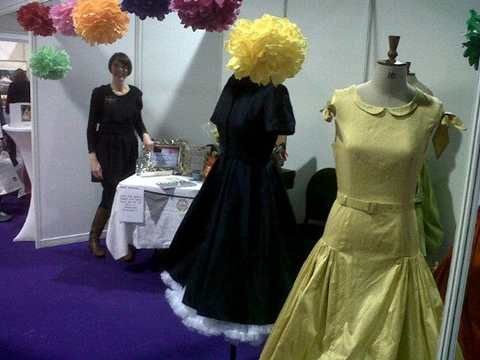
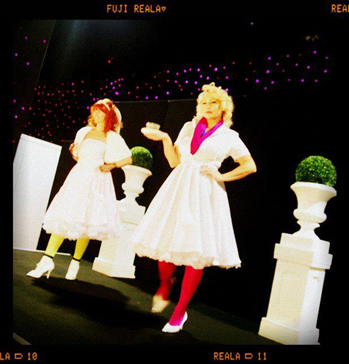
With the ambition to curate the output for this module in a cultural setting such as an exhibition within a gallery space, I recognise a need for me to develop my skills in curation. Over the years, I have gained some experience of exhibiting student work in my teaching position as I am often responsible for displaying the work of industry sponsored projects in locations such as York Castle Museum, City Screen in York City Centre and at Fairfax House. When working as a freelance designer dressmaker, I won The Best Newcomer category at The North of England Wedding Awards and the prize was a free stand at a wedding fair in Royal Armouries, Leeds. This opportunity required a creative approach to displaying bridal and occasion wear as the space was large but I had very little to put in it due to just starting out!?
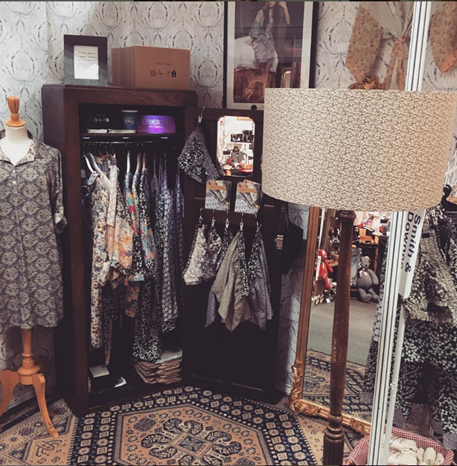
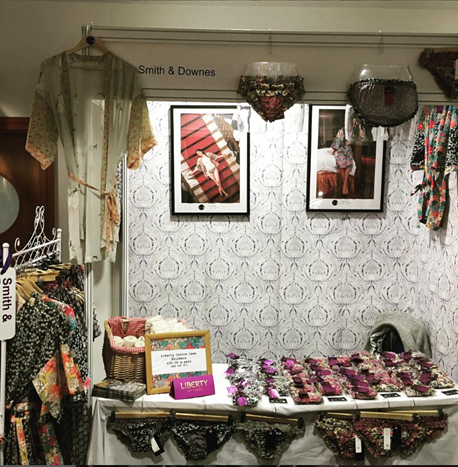
With the womens loungewear brand I owned, I traded at events such as Living North which required ‘thinking out of the box’ as we had to display in a way that attracted customers, spoke of the brand ethos and displayed our products in the best way possible. All in a tiny square space with little budget!
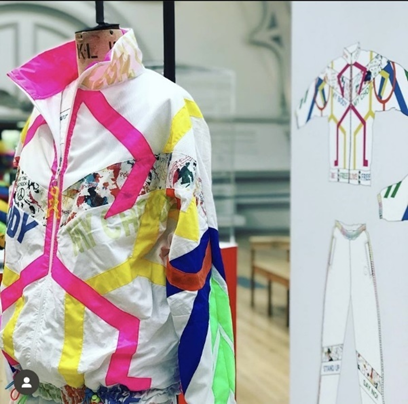
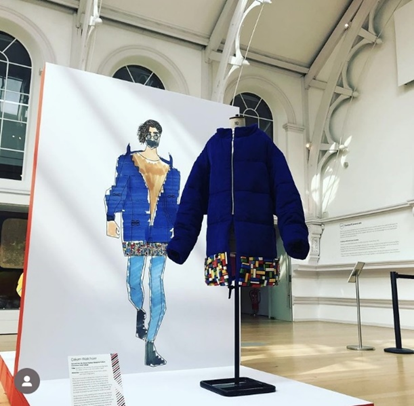
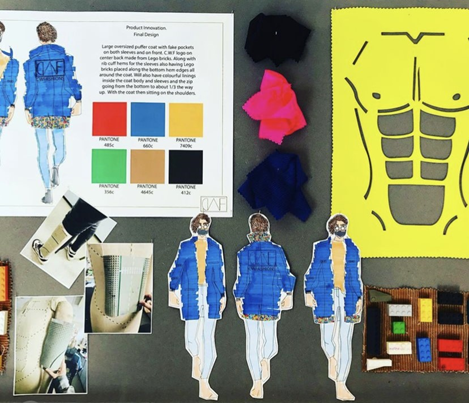
However, in my opinion, the most successful experience I have gained in curation was when I have worked as part of a team to put student work on display at York Art Gallery, to support the Grayson Perry exhibition, The Pre-Therapy Years. I gained much knowledge from working with their curator at the time, Sarah Yates, to present the student work in the best possible way. Playing with scale, layout, context, infographics and lighting in a way that met with health and safety regulations of a public gallery of this size and showcased the project in a way that drew attention to the student areas of achievement and carefully disguised those parts that were not so successful!?
The University of Huddersfield will host an exhibition of the MA graduates work in the Autumn of ’23. The opportunity to showcase work to an audience who may well be able to support me in my progression into PhD study, be it through input of specialist knowledge or being responsible for reviewing my application on to a scholarship, is exciting and I am all too aware that the way in which I showcase my project at this event will be integral to me achieving this. I would also like to celebrate the completion of this Masters by inviting my family, friends and research participants to view this exhibition and I want to feel proud of the outcome.
It is with this in mind that I approach the London trip in May ’23 as a fact finding mission. I am keen to document through photography the way in which galleries display fashion pieces and hope to take influence from some in the curation of my final outcome.
Below is a series of photographs from the MA excursion to The Design Museum, London and The Wellcome Collection, London;
Permanent Collection, The Design Museum, London;
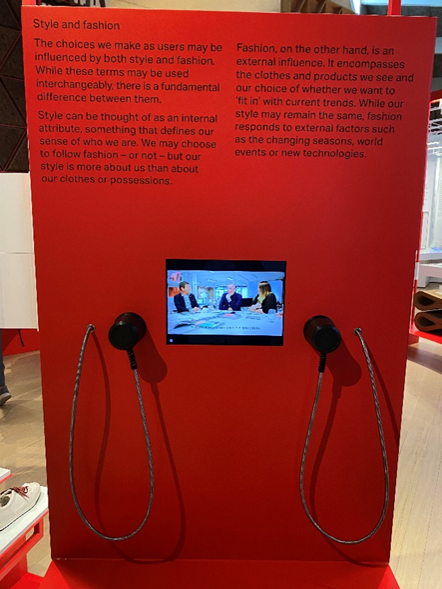
Sound; The use of these small, individual speakers to allow the audience to participate in the sound of the video is intriguing. The voice of my research participants when they talk through their memories is beautiful – I enjoy the authenticity of hearing the stories from the story tellers own mouths. The dialect and accent is part of the story that I fail to capture in the transcript of the interviews. Samuel (referenced within Abrahms (2010) pg. 12) sums up my feelings entirely when he states that ‘Ignoring the rhythms and imperfections of the spoken word, tidying up, decluttering, removing verbal tics, rendering dialect silent….. was akin in his view to vandalism.’
Information Plaques;

All too often the information that supports the art work appears to be an after thought. White background with black text is mounted on to cappa board and stuck alongside the art work. I appreciate that perhaps this is with intention, so as not to draw attention away from the art work in question. However I enjoyed the careful execution of the signage at the Yinka Ilori, Parables For Happiness, exhibition at The Design Museum. Iloris work is hugely focussed around colour, pattern and scale to develop environments that enhance wellbeing. It seems fitting therefore that the signage is printed onto a pastel pink background with a header and footer pattern that is influenced by the pattern we see in his work. The heading, larger in scale than the font that proceeds it, in a playful, soft, bubble like font draws attention to the audience in a non-aggressive, playful way that echoes the sentiment of his work.
Positioning
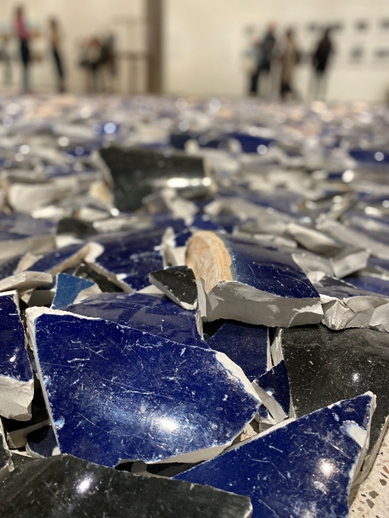
The precise positioning of an artefact within a specific space is an artform in itself (indeed one can study ‘Curation of Contemporary Art at higher degree level at The Royal College of Art). Somewhat naïvely, I hadn’t quite appreciated the involvement of the artists when an exhibition is curated until I watched a short promo film by the Hepworth, Wakefield on the recent exhibition by Sheila Hicks entitled ‘Off Grid’ (https://youtu.be/Kz6BxqYIdzo 2022). Sheila talked about the time she spent within the gallery space, meditating in the sunlight. Observing the subtleties of the space including the sounds and ambience. This directly influenced the work she went on to produce as it was made with this context in mind. I could sense this same deep involvement in the notion of placement at the Ai Wei Wei ‘Making Sense’ exhibition at The Design Museum. Careful arrangement of thousands of mysterious, unvaluable items such as teapot spouts, fragments of porcelain pieces and lego bricks are all the more impactful due to the environment within which they are placed. The huge, white space within which Ai Wei Weis’ installations are placed echoes with the buzz of the audience slowly moving between pieces. This space is the perfect, unobtrusive environment to muse over Ai Wei Weis’ work and I am allowed the freedom to contemplate the political meanings and human ingenuity of such items in equal measure.
Displaying The Process
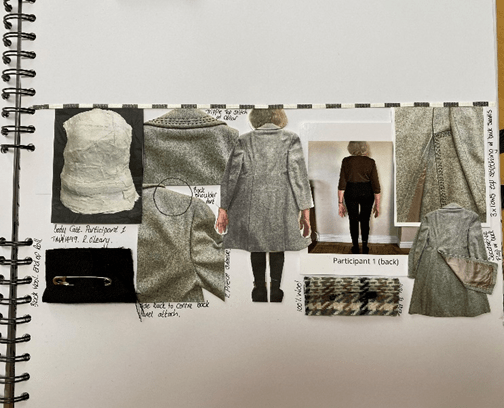
Analysing the garments that have been loaned to me by the research participants is essential before commencing the replication of them. I have found great pleasure in returning to a ‘traditional’ method of sketch booking my ideas in a paper journal through the modules that have proceeded this. I find that taking my time over page layout, presenting photographs of the garment details alongside fabric swatches, sketches and text drawn from the transcript of the interviews is cathartic and allows me to engage with the garments on a deeper level. I would like to present this research and idea development alongside the final outcome at the MA exhibition (possibly in a book format).
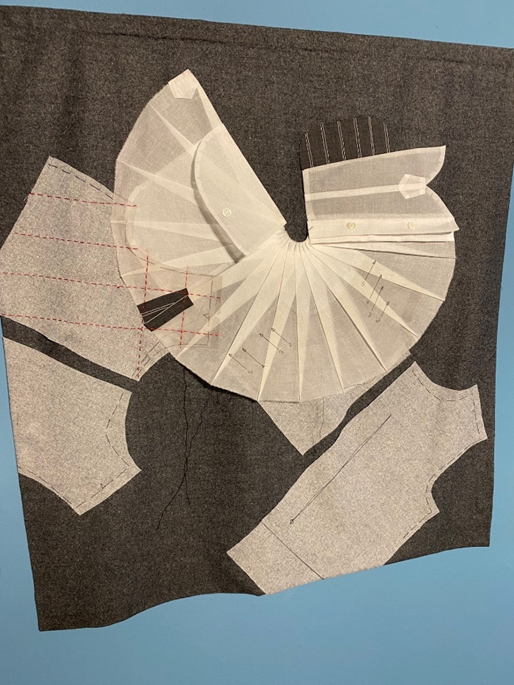
The exhibition, ‘Tailored’ at Sunny Bank Mills introduced me to the Sixty-two Group of Textile Artists. I was particularly drawn to the works of artists who presented the process as the final outcome. The works which, upon first glance appear to be unfinished, but are in fact using the processes associated with tailoring to make sense of the world around them. For example, Sian Martin who’s piece looked at the temporary tailors tack stitch, Jennifer Smith-Windsors’ ‘Inside Out’ draws attention to interlinings – the hidden protagonist of the tailored jacket and Caroline Bartlett stripping away of ornament in western masculine clothing in her piece ‘Disciplining The Surface’.
Next Steps;
- Reach out to technicians at the University to explore the potential to display my final project with sound recordings of snippets of conversation from my research participants in the final exhibition
- Question organisers regarding location of the final showcase – consider the positioning of my work in the environment
- Documenting the process – attend book making work shop with Stephen Calcutt – how can the print facility at Uni support my ambitions here?

 Blog for Rebecca O'Leary (U2183040) MA in Creative Pattern Cutting