As we had agreed in our Wednesday meeting, I embark upon writing a project brief to clarify our aims and ambitions for the project. This task is ‘in my comfort zone’ thanks to being responsible for such activities in my working life, however I face an added pressure as I am aware of the intended audience being my fellow MA students, not my under-graduate students!
To ease my anxieties I stick to a format I am familiar with and utilise the Huddersfield University MA module handbook template. The sub-headings are as follows;
- Creative Contributors
- Introduction (challenges we face)
- Considerations
- References
- Timeline
- Learning outcomes/abilities
This task forces me to embark upon my own research activity to ensure that there is in fact demand for our product and I explore themes around national challenges of commercial and cultural ideologies;
- Economic (empty shops on the British High Street. Cost of living crisis)
- Political (lack of funding for the creative industries)
- Technological (app/website to ‘match make’ isolated creatives)
- Social (are galleries elitist/inaccessible to all? Workshops within empty shops – enhanced well being)
- Ethical (providing employment opportunities for graduates from creative degrees and those creatives who work in isolation. Can our solution encourage re-emergence from lock down restrictions/enhance well being)
- Environmental (Producing outcomes that do not harm the environment. Sourced from traceable supply chains)
Producing this project brief (see appendix one) confirms that we are ‘on the right track’ as I believe that there is demand for our idea of producing a match making website for creative practitioners to meet local, like minded creatives and to develop our idea of an ‘exhibition in a box’. The concept addresses national and global issues whilst bringing all of our skills together, ensuring everyone has a part to play.
I nervously submit this to my group teams page and they agree the document! I have written the brief in a timely manner as our lecturers have announced that we will present our ideas in a presentation in this Fridays lecture – the brief supports my team mates in planning and delivering our introduction presentation.
Next Targets;
Who are the stakeholders?
Consider my creative contribution – fabrics? Fashion product? Merchandise?
APPENDIX ONE;
Master of Arts 2022/23 – University of Huddersfield
TM1402: Creative Innovation and Entrepreneurship
Project Title; “UnBoxt”
Creative Contributors are;
Rebeka But, Rebecca O’Leary, Namrata Thapar, Mitali Gopal Sawant, Jake Gibbons, Courtney Wade, Andrew Roberts, Akash Bharwad
INTRODUCTION
Our society faces a raft of cultural challenges. As we attempt to ‘build back better’ following the Covid pandemic we face unprecedented challenges; the war in Ukraine, cost of living crisis, Brexit, ageing population, rise in mental health issues, industrial strike action and loneliness to name but a few.
Never more have we needed the next generation of creative thinkers to develop solutions to these challenges. They are the change makers, visionaries and futurologists that can re-imagine a better world.
Challenge 1; Opportunities for graduates from creative degrees
Despite the British creative industries being worthmore than £115bn to the UK economy before the pandemic – more than aerospace, life sciences and the car industries combined (Sherwood, 2023), we see government policies that are characterised by incoherence and barriers to success for those creatives looking to play out their re-imaginings.
“Young and emerging designers are essential to the creative ecosystem. They are our lifeblood. The current generation is noted for its active engagement with world issues and the conviction that through their engagement, they can help bring about change. As an industry and creative community, we have a shared responsibility to provide support for them, and perhaps most importantly, learn from them. All our futures depend on it.” (Wright, 2023)
Thought; How do we create accessible opportunities for new and independent creatives to gain exposure for their work, make new connections with like-minded creatives and clients amidst muddled government policies that create barriers to success?
Challenge 2; Empty shops on British high streets
The demise of the British Highstreet poses challenges and opportunities in equal measure. 2022 was labelled as a “brutal” one for Britain’s retail sector, with more shops shutting down than at any other point in the last five years. A total of 17,145 shops on high streets and in other locations closed for good over 2022. This is up almost 50% on the 11,449 shops closed in 2021, during the Covid pandemic (Kollewe, 2023).
Thought; How do we reuse and repurpose empty or abandoned spaces? What is the British Highstreet if not a retail space?
Challenge 3; Isolation, loneliness and wellbeing
1 in 4 people will experience a mental health problem of some kind each year in England. The pandemic saw a rise in members of our society experiencing mental health problems (a third of adults and young people said their mental health got much worse since March 2020). Loneliness can be a major contributing factor to a deterioration in one’s mental health.
A report from the National Alliance for Arts, Health and Wellbeing (APPG) suggests that the arts can help to keep us well, aid recovery and support people to live longer and healthier lives. Creative activity such as painting, drawing or creative writing can create positive effects on our mental health, especially when engaging in group hobbies, or activities with a social element (McEvoy, 2020).
Thought; How do we break down boundaries to reach and build up communities whilst improving emotional wellbeing?
The House of Commons Digital, Culture, Media and Sport Committee published a report on 2nd November 2022; ‘Reimagining where we live: cultural placemaking and the levelling up agenda’. It said the arts, culture and heritage can support levelling up by engaging local communities and supporting local industry.
Can we, the Creative Contributors, bring our separate disciplines together to devise a solution to these challenges?
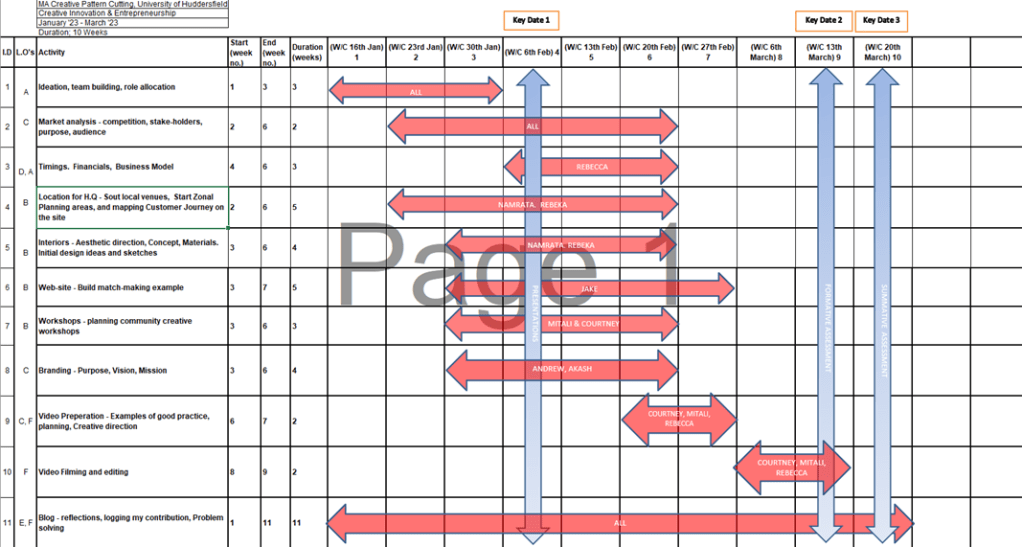
DELIVERY SCHEDULE & LINKS TO LEARNING OUTCOMES (SEE GANNT CHART);
REFERENCES;
Kollewe, J. (2023, January 2). Almost 50 UK shops closed for good every day in 2022, says report. The Guardian. https://www.theguardian.com/business/2023/jan/02/almost-50-uk-shops-closed-for-good-every-day-in-2022-says-report
McEvoy, M. (2020, February 20). How creativity and hobbies can benefit your health. Bupa. https://www.bupa.co.uk/newsroom/ourviews/creativity-hobbies-benefit-health#:~:text=A%20report%20from%20the%20National,live%20longer%20and%20healthier%20lives
Sherwood, H. (2023, January 19). Muddled policies putting UK’s lead in creative industries at risk, peers warn. The Guardian. https://www.theguardian.com/culture/2023/jan/19/muddled-policies-putting-uks-lead-in-creative-industries-at-risk-peers-warn
Wright, R. (2023, January 27). We Must Generate New Career Paths For Young People. Design Week . https://www.designweek.co.uk/issues/23-27-january-2023/rebecca-wright-we-must-generate-new-career-paths-for-young-people/

 Blog for Rebecca O'Leary (U2183040) MA in Creative Pattern Cutting