Today’s lecture was led by Catherine Brentnall from the universities ‘Enterprise Team’. I was surprised to hear from Catherine that the enterprise support offered by the university in fact extends beyond our time as students of the uni and Catherine describes it as ‘lifelong’. I doodle in my note book the statement “thinking about the future and visualising opportunities” as this resonates with me. I am in the final stages of my time on the part-time MA in Creative Pattern Cutting and am starting to consider the next steps in my future career.
Catherine sets the first task, a 2-minute quick thinking activity in which we must consider;
‘Behaviours I find unhelpful in groups are………’
‘Because………’
‘This could be kindly addressed by…….’
I have little time to ponder over my responses and am surprised by the speed at which my answers come to me.
Challenge 1;
‘Behaviours I find unhelpful in groups are dominating characters unwilling to listen to others.’
‘Because their attitude can overpower quieter members of the group.’
‘This could be kindly addressed by writing an agenda with designated contributors identified before our meetings to ensure everyone contributes equally.’
Challenge 2;
‘Behaviours I find unhelpful in groups are quietness – not contributing at all.’
‘Because I am unable to read emotions and over think the silence! I believe their silence to mean that they are unhappy or do not agree with my contributions.’
‘This could be kindly addressed by writing an agenda with designated contributors identified before our meetings to ensure everyone contributes equally. Being confident enough to invite quieter members of the group to speak.’
Challenge 3;
‘Behaviours I find unhelpful in groups are negative attitudes and a fixed mindset. A willingness to identify the flaws in peoples ideas.’
‘Because this encourages an unproductive environment in which innovation and ‘blue sky thinking’ is impossible. Almost ‘dampens the fire’ of positive, engaged people bouncing ideas off one another.’
‘This could be kindly addressed by counter acting the negativity by identifying the positives and suggesting solutions to problems.’
Catherine goes on to introduce us to a methodology that our groups might adopt when making decisions together called OPERA. As we approach a question that arises through our activity, we might consider;
O – Own
P – Pair (swap pairs, sharing ideas across different perspectives)
E – Explaining
R – Rank
A – Arrange
We have an opportunity to put this method into practice in the next task; ‘The Mayors Innovation Prize’ (The LEP, 2023).
This competition encourages us to consider how we might tackle the climate emergency and make West Yorkshire a better place to live.
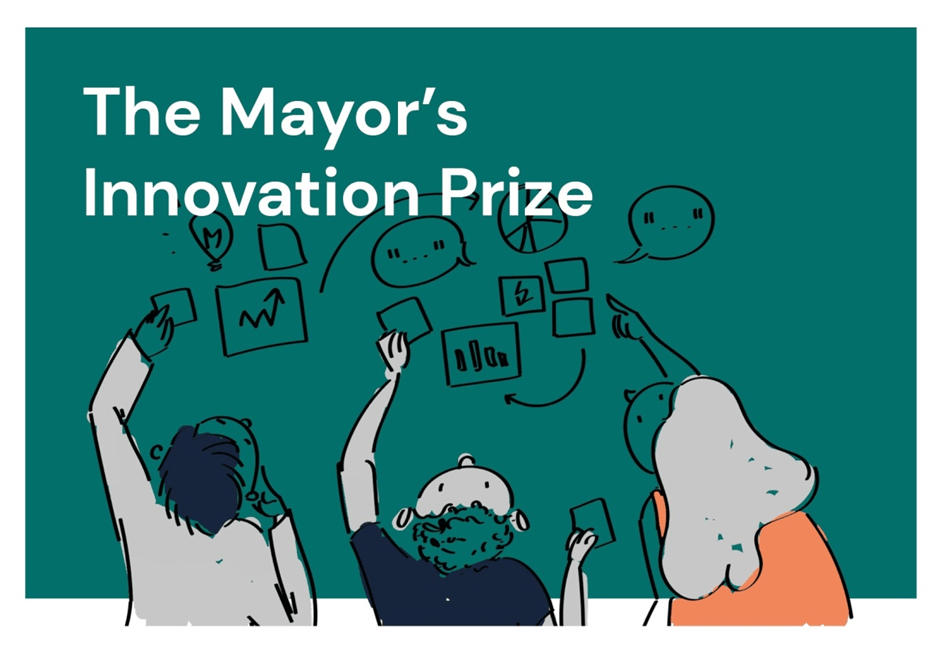
I am paired with a Graphics MA full-time student, Damien. We make quick introductions to one another before sporadically note making our ideas. In the introduction to the task Catherine explained that the most fruitful of brainstorming sessions are those in which all ideas are welcome, in quick succession with no idea being a bad idea.
Idea One; “Why are good drying days always week days”?!
I make a suggestion to Damien in which clothes drying facilities be introduced to outside spaces at workplaces across West Yorkshire. I go on to explain that, as a busy mum to two young children, my laundry pile feels never ending at times! Inevitably we, like many other families, do our laundry at weekends when our tumble drier is on an endless cycle thanks to the wet weather.
As the planet warms up, so we can expect more rainfall (and more rainy weekends!) suggesting that our tumble drier will potentially be used during times of the year that we have been able to dry clothes naturally outside on the washing line.
The cost-of-living crisis weighs heavy on our minds and a recent article by Ogden (2022) suggests that a 9kg condenser tumble dryer such as ours uses 5.2 kWh for a full load and approx 617 kWh annually. This means a cost of £1.77 per cycle and £209.78 annually.
I suggest that having washing lines installed outside the workplace would be an excellent opportunity for families to hang wet laundry up as they arrive at work, leave it out to dry over the course of the sunny, windy working day, before retrieving at the end of the working day. Therefore reducing the use of tumble driers. This would be a relatively low cost solution and make a markable difference.
Unfortunately Damien failed to share my enthusiasm for the idea (he potentially lacked empathy for my laundry woes as a single young man with only his own laundry to consider!) Sawyer (2017) suggests that “Successful innovators keep having ideas. They know that most of their ideas won’t work out and they are quick to cut their loses and pursue those few good ideas that resonate with their collaborators.” Therefore, despite my disappointment at not pursuing this concept I am aware of the time constraints on reaching a solution and decide that it is not worth while embarking upon a plea for Damien to agree the concept.
Idea Two; “Free bus travel”
We quickly begin to develop an alternative idea; free bus travel for local residents. We are both aware of the damage that traffic fumes cause upon the environment and issues in West Yorkshire related to too much traffic on the road (delayed commuter times, potholes in the road, impact upon nature and damage to people’s physical health to name a few). I confess to Damien that I in fact live on a bus route that would take me directly from home to work, but cost and time means that I choose to use the car (and shamelessly contribute to the ever-expanding commuter time!)
We ponder some solutions and settle upon an idea in which all residents would be entitled to one free return bus journey a week on any bus route. Damien’s quick calculations highlighted that this simple solution had the potential to reduce car usage by 14% and encourage commuters to adopt public transport as a viable means of travel on other days of the week also.
Evaluation;
This lecture has forced me to consider the ways in which I approach and behave within collaborative working;
- Flexibility – being prepared to ‘back down’ on my washing line idea meant that we could reach an outcome in the time set.
- Resilience – not taking Damiens refusal to pursue my idea as personal. He could not see the value in the idea and I had to quickly accept that his perspective would be shared by many others (and therefore render the idea invalid).
- Confidence – with tight deadlines I must push to one side any anxieties around appearing unknowledgeable or concerning myself with how other people perceive me and in fact share my ideas quickly and with confidence.
- Commitment – being entirely focussed upon the task at hand and engaged in the conversation without distraction. Rearranging furniture in the classroom so I was facing Damien, had my note pad and pen ready for note making and placing my phone/laptop in my bag meant I had no distractions and was engaged in our conversation.
- Kindness – I recognised that Damien was perhaps not quite so comfortable with the situation and didn’t share his ideas as readily as I did. I asked open ended questions, invited him to contribute his ideas and encouraged them when he did contribute.
References;
Leeds City Region Enterprise Partnership. (2023). The Mayors Innovation Prize. The-LEP. https://www.the-lep.com/the-mayors-innovation-prize-terms-and-conditions/#:~:text=Eligibility%20and%20skill%20criteria,on%20the%2022nd%20January%202023.
Ogden, r. (2022, December 12). How much does it cost to run a tumble dryer after the October price cap rise?. Ideal Home. https://www.idealhome.co.uk/property-advice/how-much-does-it-cost-to-run-a-tumble-dryer-295558

 Blog for Rebecca O'Leary (U2183040) MA in Creative Pattern Cutting