“Rethinking economics is not about finding the correct one (because it doesn’t exist), it’s about choosing or creating one that best serves our purpose – reflecting the context we face, the values we hold, and the aims we have”.
Raworth (2018)
I was motivated by our team meeting chats in which we explored our personal values and how we aspired to design a project that placed community and place making at the heart of our aims and objectives. We never talked about GDP being a marker of our success and in fact all of us wanted to develop a business plan that challenged traditional commercial ideologies. We were influenced by not-for-profit companies who placed social justice and environmental wellbeing at the heart of their decision making rather than profit. This mode of economics is recognised as being hugely beneficial when companies attempt to initiate more innovative ways of thinking from their employees. Indeed GlaxoSmithKline fosters cross-fertilisation with its non-profits. Employees work full time for a non-profit for six months, and then return with fresh ideas and new ways of thinking (Sawyer, 2017).
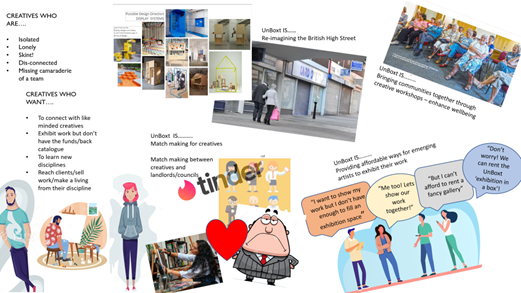
Sawyer (2017) suggests that customer webs are where real innovation comes from and UnBoxt only exists through an active and engaging ‘customer web’ of creative individuals outlined in Figure One. Creatives can build a social ‘profile’ on the UnBoxt website to begin ‘matching’ with others and forming networks of likeminded individuals with shared values and aims. I joked in the presentation that this process was akin to Tinder but for creatives (and less smutty!) Although this was a light-hearted way of describing the process, analogies such as this help to develop new conceptual combinations and are essential to collaborative creativity and they are more likely to emerge when participants bring their various experiences to the table (Sawyer, 2017). By comparing our networking project to Tinder, it meant that the vast audience, from varying backgrounds, cultures and disciplines, understood the concept much better.
Once users have formed ‘mini-networks’ via the UnBoxt website, we can support them to come together physically to exhibit their work in shared spaces. These shared spaces are the empty shops of private landlords and councils across the world – a reimagining of the Highstreet to become both a commercial and non-commercial entrepreneurial environment. Community engagement such as viewing artist works, enjoying the café, attending artist workshops and bringing artefacts to contribute to the digital time capsule, is imperative to the business and is achieved through recognisable and engaging branding, emulated throughout the business.
Upon reflection, UnBoxt as a business proposal is viable and I believe a successful alternative to the cultural and commercial ideologies of a somewhat archaic economic system in which success is measured by monetary profit.
Areas of success;
- UnBoxt is designed in line with modern thinking around current economics. Specifically Kate Raeworths ‘Doughnut Economics’ (2018);
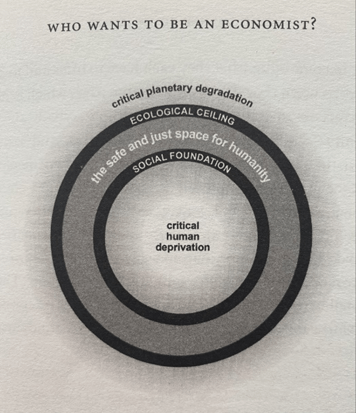
Below the inner ring of the ‘doughnut’ lies critical human deprivations and beyond the outer ring of the doughnut is the ecological ceiling; critical planetary degradation such as climate change and biodiversity loss.
- A network or web of likeminded, value driven creatives and local communities are at the heart of the project. The ‘time capsule’ for example is entirely reliant upon the customer web contributing ideas and offers potential to result in innovative outcomes that truly speak of a place and moment in time
- No specific job roles allocated worked in our favour. At first, I felt anxious that we hadn’t allocated job roles as was suggested by our lecturers in the introductory session. However, by working within a smaller team with fewer hierarchal levels and undefined job roles we became more innovative (Sawyer, 2017). By having less bureaucracy, team members switched from role to role as and when the occasion arose, removing the egotistical ownership of ‘being in charge of one area’ and I believe encouraged innovation
- Sawyer (2017) suggests that “collaborative organizations are able to adapt and respond to market shifts and continue growing”. UnBoxt provides opportunities to scale up, flex and adapt as market demand/ecologies change due to the transient, temporary nature of the ‘pop up’ exhibition fixtures and fittings that lend themselves to being erected in various places in which communities gather
- The project showcases our skillset within each discipline and forced us to stretch our existing capabilities and knowledge around subject specific skills
Areas for development;
- True group genius takes time to evolve (Sawyer, 2017). We had just got started! There are members of the team that I would like to work with in the future and we have discussed setting up a ‘study group’ to support one another through our remaining time on the MA.
- Narrow down the formula. Being mindful to design a project in which everyone would contribute/benefit meant that potentially the concept was so big that we didn’t ‘dig deep’ in to just one area.
- Workshops – In hindsight, my research into funding streams to kick start our business came too late. I wish I had discussed my ideas around creative workshops with my teammates who took ownership of this aspect of the project. To access funding such as the ‘Creative People & Places Programme’ it was important to design workshops that aim to empower people who attend them to ‘think differently’, however our workshops were focussed upon mindfulness and mental wellbeing rather than upskilling.
References;
Raworth, K. (2018). Doughnut Economics (2nd ed.). Penguin Random House UK.
Sawyer, K. (2017). Group Genius (3rd ed.). Basic Books

 Blog for Rebecca O'Leary (U2183040) MA in Creative Pattern Cutting